
Send the abstracts
and full papers
Interested authors may send the abstract and full paper to cewss.wu@gmail.com from now to 28th February 2026.
Selected papers will be notified with an invitation letter via e-mail by 5th March 2026.
In the 21st-century context, characterized by fluid cultural boundaries and the “post-truth” crisis, narratives have emerged as dynamic mechanisms of power that define, construct, and deconstruct social reality. Examining narratives through the lens of world literature transcends mere aesthetic analysis; it positions literature as a “social archive” that unearths suppressed historical fragments and the voices of marginalized groups excluded from mainstream discourse. Analyzing the power of narrative in this contemporary light is essential for reinterpreting historical accounts, thereby fostering a holistic understanding of the root causes of conflict and social transformation.
Contemporary gender dynamics have transcended binary frameworks, evolving into a more complex and multifaceted global landscape. Consequently, world literature serves as a vital intellectual space for dismantling the authoritarian structures that govern human identity, while simultaneously establishing new definitions aligned with the principles of equality. This conference seeks to analyze the role of narratives in driving structural change through an interdisciplinary lens, encompassing literary criticism, sociology, and anthropology. The objective is to decipher the power dynamics embedded in texts, which function as both a reflection of and a catalyst for paradigm shifts regarding gender and social structures across diverse cultural contexts.
Amidst the rapid digital transformations of the 21st century, establishing international academic collaborations is essential for developing knowledge that remains responsive to global phenomena. The International Conference on “The Power of Storytelling” was established to provide a global platform for scholars and thinkers to exchange cutting-edge research. It seeks to cultivate a robust intellectual network dedicated to finding novel explanations for sociocultural phenomena through an evolving humanities lens. Ultimately, this initiative serves as a vital foundation for fostering mutual understanding and equipping humanity to navigate emerging challenges with both strategic vision and ethical integrity.
Beyond academic rigor, this program is dedicated to advancing humanities education in a manner that addresses pressing global exigencies, including environmental crises, systemic inequality, and the complexities of identity. Through international scholarly collaboration, the program facilitates the exchange of pioneering research paradigms and innovative methodologies. Such synergy aims to generate actionable knowledge capable of addressing societal issues and informing the development of cultural policies that prioritize peaceful coexistence within increasingly diverse societies.
Analyzing the power of narrative through world literature provides a crucial framework for enhancing empathy and intercultural understanding. This conference marks a significant advancement in preparing society for future complexities through the integration of ethics and visionary leadership. By exploring the human experience through global narratives, the program aims to transmit inspiration and drive sustainable social transformation for future generations.
- To establish a scholarly forum for the exchange of interdisciplinary knowledge across literary criticism, history, and sociology.
- To analyze the agency of narratives in driving and redefining gender dynamics and social structures.
- To foster international academic collaboration networks aimed at advancing humanities education in response to global transformations.
Core Themes: Language, Culture, Gender, and Folklore We invite submissions that explore, but are not limited to, the following areas
- Historical Studies: Multi-dimensional research in various historical contexts.
- Diversity and Identity: Studies on multiculturalism and social representation.
- Gender Studies: Exploration of gender roles and queer theory.
- Folklore and Mythology: Traditional narratives and local wisdom.
- Linguistics: Language, discourse analysis, and sociolinguistics.
- Regional History: Specifically the history of Southern Thailand.
- Narrative History: Oral histories and the construction of memory and alternative history
- Chronicles and Archives: Analysis of Pongsawadan (chronicles) and classical records.
- Methodology: Innovative approaches to data collection in linguistics, gender studies, and history.
- Diaspora, Narrative, and Sense of Belonging: marginalized group and resilient voices.
- Keynote Addresses: Special academic lectures by distinguished scholars.
- Oral Presentations: Parallel sessions for individual research paper presentations.
- Panel Discussions: Interdisciplinary forums for thematic debate and exchange.
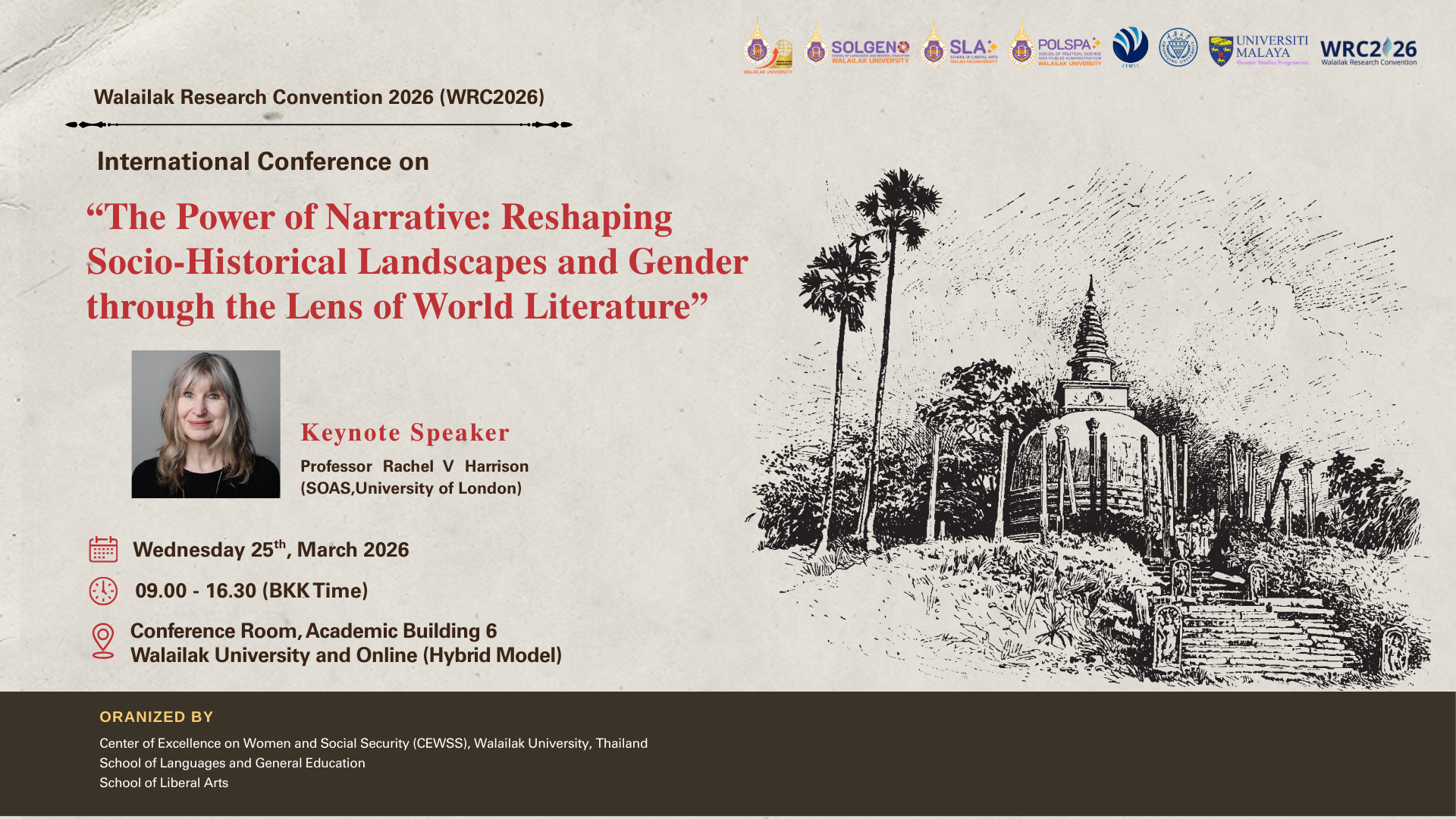
Keynote Speaker: Professor Rachel V. Harrison, Ph.D. SOAS University of London, United Kingdom
Invited Speakers (Special panel)
- Professor Yuan Jifeng, Ph.D. School of Foreign Languages and Cultures, Chongqing University, China
- Farhana Binti Abdul Fatah, senior lecturer, Ph.D. Applied Linguistic, Gender Studies, Faculty of Arts and Social Sciences, University of Malaya
- Associate Professor Ranwarat Kobsirithiwara, PhD Department of Literature Faculty of Humanities Kasetsart University and Deputy Director Rajanagarindra Institute of Linguistic and Cultural Studies Faculty of Humanities
- Associate Professor Saowarit Choolawong, Ph.D. Department of Thai, Faculty of Liberal Arts, Thammasat University
- Assistant Professor Saranpat Boonhok, Ph.D. Thai Language Program, Faculty of Education, Suan Sunandha Rajabhat University
- Wanviwat Rattanalumpu, Ph.D. Institute of Continuing Education and Human Resources, Thammasat University
- Danai Ployplai, Ph.D. Thai as a Foreign Language Program, Faculty of Arts, Chulalongkorn University
Total Estimated Participants 150
- Researchers and Scholars Local and international experts in the humanities and social sciences.
- Faculty and Students Academic staff, as well as undergraduate and graduate students.
- Civil Society Organizations (CSOs) Representatives from NGOs and community-based organizations.
- Media Practitioners Journalists and content creators interested in cultural discourse.
- General Public Individuals interested in storytelling, history, and social issues.
- Date: Wednesday, March 25, 2026
- Time: 09:00 – 16:30 (GMT+7)
- Venue: Conference Room, Academic Building 6Walailak University
- Format: Hybrid (On-site and Online)
- February 1 – 28, 2026: Submission period for abstracts and full papers.
- March 1 – 9, 2026: Peer review and editorial assessment process.
- March 10, 2026: Notification of acceptance.
- Papers must be 6,000-8,000 words in length and must include an abstract of up to 300 words.
- Three to five keywords must be listed at the end of the abstract.
- The APA reference style is recommended.
- Submitted abstracts and papers are only accepted in Microsoft Word format.
- Students: 500 Baht
- Researchers, lecturers and all interested participants: 800 Baht
Day 1: March 24, 2026
| Time (BKK Time) | Programs | Remark |
| 12.30-13.00 | Registration | Online / onsite |
| 13.00-14.30 | Special Panel: “Ayutthaya in Nakhon: Narratives and Urban Memories“(Conducted in Thai) 1. Ass. Prof. Piyachat Suongtee School of Languages and General Education, Walailak University 2. Ajarn Manawat Promrat School of Languages and General Education, Walailak University | Master of ceremony: Moderator:
|
Day 2: March 25, 2026
| Time (BKK Time) | Programs | Remark |
| 08.30-08.45 | Registration | Online / onsite |
| 08.45-09.00 | Conference Report By Asst. Prof. Dr. Taweeluck Pollachom Head of Center of Exellence on Women and Social Security, Walailak University Opening Remarks: By Assoc. Prof. Dr. Wichitpan Rongwong Acting Director of the Institute for Promotion of Research and Innovation towards Excellence | Master ceremony: Ajarn Pavirasa Praditson Ajarn Anggi Auliyani Suharja School of Languages and General Education, Walailak University |
| 09.00-09.30 | Opening Performance By Thai Dance Program, School of Education, Walailak University | |
| 09.30-09.45 | Introducing Keynote Speaker Professor Rachel V. Harrison By Ajarn Krisada Kantichol School of Languages and General Education, Walailak University | |
| 09.45-10.35 | Keynote Speaker: “Thai Literature as World Literature: Thai Culture as World Culture” Professor Rachel V. Harrison SOAS, University of London | |
| 10.35-10.45 | Coffee break | |
| 10.45-12.00 | Plenary Session: “The Power of Narrative: Reshaping Socio-Historical Landscapes and Gender through the Lens of World Literature” 1. Development Paths for International Chinese Language Education under the New Liberal Arts Initiative and the Concept of “Big Literature” By Professor Dr.Yuan Jifeng School of Foreign Languages and Cultures, Chongqing University, China 2. Literature as Gendered Memory: Women’s Narrative, Trauma, and the Writing of Southeast Asian Histories By Assoc. Prof. Dr. Ranwarat Kobsirithiwara Department of Literature, Faculty of Humanities Kasetsart University and Deputy Director of Rajanagarindra Institute of Linguistics and Cultural Studies, Faculty of Humanities, Kasetsart University 3. Performing (Im)piety: (Non)Veiling and the Discursive Construction of Muslim Women’s Agency on Malaysian TV By Dr. Farhana Binti Abdul Fatah Senior Lecturer, Gender Studies Programme, Faculty of Arts and Social Sciences, Universiti Malaya 4. Silenced Voices under Gardens and Skies: Gendered Memory in Malaysian Fiction By Dr.Nadirah Binti Mat Pozian Senior Lecturer, Gender Studies Programme, Faculty of Arts and Social Sciences Universiti Malaya | Moderator: Asst. Prof. Phitsinee Koad School of Languages and General Education, Walailak University |
| 12.00-13.00 | Lunch Break | |
| 13.00-14.30 | Special Discussion: “Perspectives through Contemporary Literature: History, Gender, and Thai Politics after the 1932 Revolution” (Conducted in Thai) 1. Contemporary Thai politics in Thai Literature: Changes in Representation By Assoc. Prof. Dr. Saowanit Chunlawong Department of Thai, Faculty of Liberal Arts, Thammasat University 2. Insects, Sex, and Gender in Thai Literature By Dr. Wanwiwat Ruttanalum Institute of Continuing Education and Human Resources, Thammasat University 3. The Representation of Thai Women in Thai as a Foreign Language Textbooks By Dr. Danai Ployplai Center for Thai as a Foreign Language, Faculty of Arts, Chulalongkorn University 4. Gender and the Nation in Thai Time-Travel Novels and Dramas By Asst. Prof. Dr. Saranpat Boonhok Thai Language Program, Faculty of Education, Suan Sunandha Rajabhat University | Moderator: Dr. Chutacaphat Rattanaphan |
| 14.30-14.45 | Coffee break | |
| 14.45-16.00 | Presentation Session (Panel) 1: 1. The evolution of Medusa from a frightening object to a self-determining subject through the reshaping of socio historical narratives in Greco-Roman literature and contemporary cinema By Professor E. A. D. A. Edirisinghe Department of Sociology, Faculty of Social Sciences, University of Kelaniya, Sri Laka R. M. D. S. Randiwela Department of Western Classical Culture and Christian Culture, Faculty of Humanities, University of Kelaniya, Sri Laka K. A. H. N. Karunanayake Coordinator, Centre for Gender Studies, University of Kelaniya, Sri Laka 2. Deconstructing the Female Body: Gender, Power, and the Reversal of the Gaze in Najat El Hachmi’s The Body Hunter By Assoc. Prof. Wissam BITARI Faculty of Oussoul Eddine, Abdelmalek Essadi University, Tetouan, Morocco 3. Chronicles from the Margins: Archival Traces of Bihar’s Unsung Women in the Freedom Struggle By Zeenat Mahzabin Research Student, Centre for Women’s Studies & Development, Banaras Hindu University, Varanasi, India | Discussant:
Moderator: |
| Presentation Session (Panel) 2: 1. Social Representations of Death in Southern Thai Buddhism: A Moscovician Perspective By Arash Mousavi School of Languages and General Education, Walailak University 2. From Victims to Ancestors: Reclaiming the Social Life of the Dead and Narrative Healing in Post-Khmer Rouge Cambodia By Thitarat Panchana Faculty of Liberal Arts, Ubon Ratchathani University 3. Narrating Care and Its Silences: Gender, Ageing, and the Familial Politics of Responsibility in How to Make Millions Before Grandma Dies By Kwanchanok Jaisuekun Institute for Population and Social Research, Mahidol University | Discussant: Assoc. Prof. Dr. Saowanit Chunlawong
Moderator: School of Political Science and Public Administration, Walailak University | |
| Presentation Session (Panel) 3: 1. LGBTQ+as subaltern community: a comparative studies in India and Thailand By Wasiya Taweewitchakariya Ph.D. Candidate, Faculty of Political Science, University of Delhi, India 2. Quiet Refusal: Somatic Resistence and the Infrapolitics of Belonging in Phuket Baba foodspace By Thanyawee Chuanchuen Ph.D. Candidate in Social Science (International Program), Faculty of Social Science, Chiang Mai University 3. Study on Contrastive Analysis of Korean ‘-get-’ and ‘-(eu)l geot’ and Thai ‘cha’ , and Pedagogical Implications for Thai Learners of Korean By Kittichon Khoatkham Faculty of Humanities, Srinakharinwirot University | Discussant: Assoc. Prof. Dr. Ranwarat Kobsirithiwara Department of Literature, Faculty of Humanities, Kasetsart University and Deputy Director of Rajanagarindra Institute of Linguistics and Cultural Studies, Faculty of Humanities, Kasetsart University
Moderator: School of Political Science and Public Administration, Walailak University | |
| Presentation Session (Panel) 4: 1. Storytelling Techniques: A Comparative Study of Howl’s Moving Castle Novel and Film Adaptation By Thikhamphon Raksaithong Fourth-year student, English Program, School of Liberal Arts, Walailak University 2. The Representation of Social Injustice in Oliver Twist: A Study of Dickens’ Critique of Victorian Society By Pimwipha Saeang Fourth-year student, English Program, School of Liberal Arts, Walailak University | Discussant: Dr. Danai Ployplai Center for Thai as a Foreign Language, Faculty of Arts, Chulalongkorn University
Moderator: School of Languages and General Education, Walailak University | |
| 16.00-16.30 | Closing Ceremony |
Establishment of Global Academic Networks To foster robust international collaborations among scholars, researchers, and educational institutions across diverse cultural backgrounds, creating a sustainable foundation for future intellectual exchange.
Advancement of the Body of Knowledge To elevate theoretical discourse and conceptual innovation, leading to the accumulation of a contemporary “Body of Knowledge.” This focuses specifically on the role of narrative as a catalyst for understanding history, gender dynamics, and societal evolution.
Policy Transformation and Social Impact To generate actionable insights that serve as a critical database for Social and Cultural Policy recommendations. This outcome aims to drive meaningful social change, particularly in historical interpretation, fostering gender diversity awareness, and reducing social inequalities.