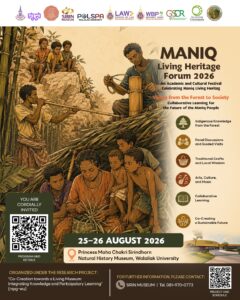
An Academic Symposium and Cultural Festival
“Voices from the Forest to Society”
Collaborative Learning for the Future of the Maniq People
25–26 August 2026
The Sirin Natural History Museum, Walailak University
Nakhon Si Thammarat, Thailand
Inter–Asia Cultural Studies Society, Sirin Musuem, Walailak Botanic Park, School of Political Science and Public Administration, School of Law and Center of Geosocial and Cultural Research for Sustainable Development, Walailak University
At Sirin Museum, Walailak University, NakhonSithammarat, Thailand
The symposium is under the research project: Co–Creation Towards a Living Museum: Integrating Knowledge and Participatory Learning supported by Plant Genetic Conservation Project Under the Royal Initiative of Her Royal Highness Princess Maha Chakri Sirindhorn (RSPG)
Who Are the Maniq? The Maniq are among the oldest Indigenous peoples of the Malay Peninsula. They are part of a wider constellation of Indigenous forest communities found across Peninsular Thailand and Malaysia and are historically connected to other Indigenous populations throughout Island Southeast Asia. Although these communities have developed distinct languages, cultures, and histories, they share long-standing relationships with tropical forests and diverse ecological landscapes. The Maniq are known by different names in different places and historical records, including Maniq, Mani, Menriq, Meniq, and, in older literature, Sakai. In Thailand, Maniq communities are found primarily in the forested mountain ranges of the southern peninsula, including Yala, Satun, Trang, Phatthalung, and Nakhon Si Thammarat. However, many communities regard Sakai as an outdated and pejorative colonial term, and therefore prefer to use their own community names. Related communities also live in Peninsular Malaysia, where they are recognized as part of the Orang Asli, particularly among the Northern Aslian-speaking groups. Beyond the Malay Peninsula, anthropologists have noted historical and genetic connections with other Indigenous peoples of Island Southeast Asia, including communities in the Andaman Islands, the Philippines, and parts of eastern Indonesia. These communities reflect the remarkable diversity and deep human history of the region.
The Maniq have maintained knowledge of forests, wildlife, medicinal plants, seasonal cycles, and reciprocal relationships with the natural environment for thousands of years. Therefore, their history demonstrates that tropical forests are not empty wilderness but living cultural landscapes shaped through generations of Indigenous knowledge and stewardship. Today, however, rapid economic and social change, together with shifting government policies, has created significant challenges for the continuity of Maniq ways of life. These include the intergenerational transmission of knowledge, access to rights, and broader public understanding of their culture and identity. Walailak University has been conducting research on the Maniq community through the development of a Living Museum initiative. The project adopts a co-creation approach that brings together researchers, community members, and partner organizations to collaboratively produce knowledge, strengthen community ownership, and develop a sustainable learning space rooted in the lived experiences of the Maniq people.
To share the outcomes of this research with a wider audience, Walailak University is organizing the Maniq Living Heritage Forum 2026. The symposium combines academic presentations, community dialogues, exhibitions, documentary screenings, cultural performances, hands-on workshops on traditional knowledge, and a cultural marketplace. More importantly, it seeks to create a shared learning space where the Maniq community, academics, students, government agencies, civil society organizations, and the wider public can engage in meaningful dialogue and collaborative learning.
Objectives
- To share knowledge and research on the Maniq people with the wider public.
- To provide a platform for Maniq community members to tell their own stories and share their lived experiences.
- To foster greater public understanding and reduce prejudice towards Indigenous and ethnic communities.
- To promote participatory learning through the concept and practice of a Living Museum.
- To strengthen collaborative networks in research, education, and cultural heritage preservation.
There are 3 Forum Formats
- Academic Forum
Panel discussions, keynote lectures, and research presentations by scholars, community researchers, students, and practitioners on Indigenous knowledge, cultural heritage, living museums, and participatory research.
- Living Museum
An interactive learning space led by Maniq community members, featuring demonstrations of traditional knowledge, forest-based practices, storytelling, language, crafts, music, and everyday cultural experiences. Visitors are encouraged to learn through dialogue and direct participation.
- Student and Digital Media Showcase
Creative projects by university students and young media practitioners, including documentary films, digital storytelling, multimedia installations, photography, podcasts, and interactive exhibitions that communicate Maniq heritage through contemporary media.
Activities Throughout the Forum
Throughout the event, participants are invited to explore a range of exhibitions, learning spaces, and cultural activities, including:
- Maniq Ethnographic Photography Exhibition – documenting the everyday lives, landscapes, and cultural heritage of the Maniq people.
- Books and Research Showcase – featuring publications, research findings, and educational resources on the Maniq community and related topics.
- Maniq Language Corner – an interactive space to learn basic Maniq vocabulary, expressions, and language through engaging activities.
- Children’s Learning Corner – creative and educational activities designed for children and families.
- Photo Booth – a space for visitors to capture memorable moments inspired by the forum’s theme.
- Cultural Market – local products, handicrafts, community-based enterprises, food, and cultural products from participating communities and partner organizations.
Program Schedule
Day 1: Tuesday, 25 August 2026
| Time | Program |
| 13.00 – 13.30 | Registration and Museum Visit Participants register and visit the Maniq Ethnographic Museum. |
| 13.30 – 14.00 | Opening Ceremony Welcome Remarks: Dr.Siriporn SomboonbooranaWelcome Speech: Director of Walailak Botanic ParkOpening Address: President of Walailak University |
| 14.00 – 14.30 | Exhibition Opening
Featured exhibitions include: • Maniq Ethnographic Photography Exhibition • Traditional Tools and Everyday Utensils • Maniq Children’s Artwork Exhibition • Interactive QR-Based Learning Exhibition |
| 14.30 – 14.45 | Coffee Break |
| 14.45 – 16.30 | Screening of the Documentary: Maniq Chronicles : The Jungle’s LegacyFollowed by a conversation and Q&A session with the documentary director, research team, and Maniq community representatives. |
| 16.30 – 17.00 | Rewards: “Leave Your Voice“ |
| 18.00–19.00
|
Dinner Reception |
Day 2: Wednesday, 26 August 2026
The Forum on Maniq and Politics of Indigenous Knowledge in Inter–Asia
| Time | |
| 08.00 – 08.30 น. | Registration |
| Mr. Pete Pimarnprom, School of Law, Walailak University (MC) | |
| 08.30 – 09.30 น. | องค์ปาฐก: ดร.ปิยะรัษฎ์ ปริญญาพงษ์ เจริญทรัพย์
Keynote: Dr. Piyarat Parinyapong Charoensap ปาฐกถาพิเศษ “พฤกษศาสตร์พื้นบ้านในบริบทของ อพ.สธ.” (Ethnobotany in the Context of the Plant Genetic Conservation Project under the Royal Initiative (RSPG)) |
| 09.30 – 10.30 น. | From “Who They Are?” to “Who Defines Who They Are?“: Politics of Indigenous Knowledge in Asia? |
| 1. Prof. Dr. Prasenjit Biswas, School of Humanities, Northern Hill University, India | |
| 2. Dr Alexander Horstmann, Faculty of Political Science, Chulalongkorn University | |
| 3. Assist.Prof.Dr. Siriporn Somboonboorana, Center of Geosocial and Cultural Research for Sustainable Development, Walailak University, Thailand | |
| 4. Dr. Anusorn Chaiaksornwet, School of Political Science and Public Administrations, Walailak University (Moderator) | |
| 10.30 – 10.45 น. | Coffee Break |
| 10.45 – 12.30 น. | State Power, Law, and the Refusal of Indigenous Peoples |
| 1. Mr. Setthawut Kongten, Head of Governance, Compliance & Risk, World Vision foundation of Thailand, Thailand | |
| 2. Ms. Naiyana Thanawattho, Executive Director, Asylum Access Thailand Foundation, Thailand | |
| 3. Ms. Alfina qisthi, Human Rights Advocator, Indonesia | |
| 4. Ms. Elzaveta Stikhina, Law student, Saint Petersburg, Russia | |
| 5. Assoc. Prof. Qin Jie, School of Civil and Commercial Law, Southwest University of Political Science and Law (SWUPL), China | |
| 6. Ms. Sawettachat Jubsilp, School of Laws, Walailak University, Thailand | |
| 7. Mr. Pete Pimarnprom, School of Law, Walailak University (Moderator) | |
| 12.30 – 13.30 น. | Lunch |
| 13.30 – 14.30 น. | Indigenous Knowledge, Forests, and Environmental Justice |
| 1. Dr. Maine Suadik, Faculty of Social Sciences and Humanities, Universiti, Malaysia Sabah Sabah, Malaysia | |
| 2. Ms. Sasiwimol Kongsuwan, School of Languages and General Education, Walailak University, Thailand | |
| 3. Mr. Rishanglang Nongrum, PhD. Student, North-Eastern Hill University Shillong,India | |
| 4. Ms.Sawettachat Jubsilp, School of Law, Walailak University (Moderator) | |
| 14.30 – 14.45 น. | Coffee Break |
| 14.45 – 16.30 น. | Roundtable Dialogue: “From the Forest to Society: Multi–Stakeholder Collaboration for the Protection and Well–being of the Maniq People” (in Thai) |
| 1. Associate Professor Dr. Prapart Pintobtang, Senetor (The Committee on Political Development, Public Participation, Human Rights, Liberties, and Consumer Protection) | |
| 2. Mr. Thiwakon Kaewbounsong, Mayor of the Nong Thong Subdistrict Administrative Organization, Nong Thong SAO, Pa Bon District, Phatthalung Province. | |
| 3. Dr.Pariwat Changkid, Ranong Community College, Ranong | |
| 4. Mr. Chumsak Nararatwong, Independent Researcher | |
| 5. Mr.Jaroon Thotsakun (Thao Roon) | |
| 6. Mr. Piyanan Jina. Walailak University (Moderator) | |
| 16.30 – 17.00 น. | Closing Plenary & Walailak Declaration on Indigenous Knowledge and Living Museum |