
Sueptrakool Wisessombat

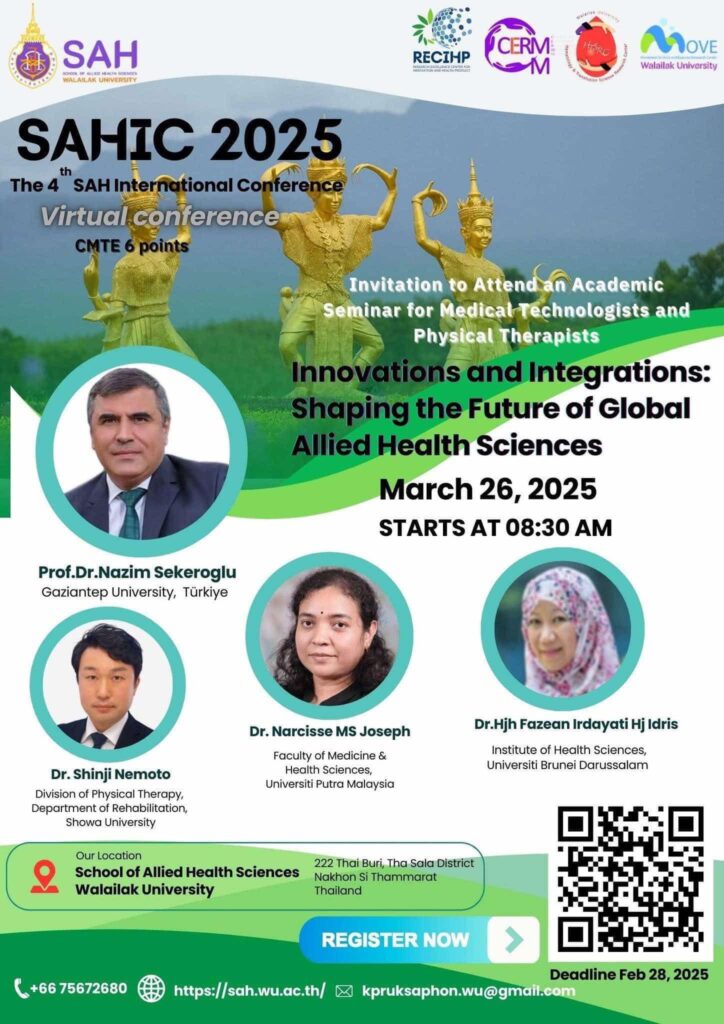
SAHIC 2025 – The 4th SAH International Conference March 26, 2025 | 08:30 AM

SAHIC 2025 – The 4th SAH International Conference Virtual Conference | March 26, 2025 | Starts at 08:30 AM Innovations and Integrations: Shaping the Future of Global Allied Health Sciences Join us for cutting-edge research presentations from international experts in Allied Health Sciences!   Keynote Speakers: Dr. Shinji Nemoto (Showa University) – Muscle Oxygenation Dynamics […]

SAHIC 2025 – The 4th SAH International Conference March 26, 2025 | 08:30 AM Read More »

Anti-inflammatory, antioxidant, and anti-apoptotic properties of Thunbergia laurifolia Lindl. aqueous leaf extract on LPS-stimulated RAW 264.7 macrophages. South African Journal of Botany

Abstract Senghoi, W., Konsue. N., Qind. S., Klangbud, W,K, (2024) Anti-inflammatory, antioxidant, and anti-apoptotic properties of Thunbergia laurifolia Lindl. aqueous leaf extract on LPS-stimulated RAW 264.7 macrophages. South African Journal of Botany (Manuscript has been accepted for publication: 25/9/2024) Pecentile 79     https://doi.org/10.7717/peerj.16494  

Anti-inflammatory, antioxidant, and anti-apoptotic properties of Thunbergia laurifolia Lindl. aqueous leaf extract on LPS-stimulated RAW 264.7 macrophages. South African Journal of Botany Read More »

Antioxidant activity, anti-tyrosinase activity, molecular docking studies, and molecular dynamic simulation of active compounds found in nipa palm vinegar

Abstract Tyrosinase is a key enzyme in melanogenesis and its inhibitors have become increasingly because of their potential activity as hypopigmenting agents which have less side effects. Nipa palm vinegar is an aqueous product that is normally used as a food supplement. The aim of this study was to study the determination of antioxidant activity

Antioxidant activity, anti-tyrosinase activity, molecular docking studies, and molecular dynamic simulation of active compounds found in nipa palm vinegar Read More »

The microbial damage and host response framework: lesson learned from pathogenic survival trajectories and immunoinflammatory responses of Talaromyces marneffei infection

Abstract The adverse outcomes of fungal infection in mammalian hosts depend on the complex interactions between the host immune system and pathogen virulence-associated traits. The main clinical problems arise when the host response is either too weak to effectively eliminate the pathogen or overly aggressive, resulting in host tissue damage rather than protection. This article

The microbial damage and host response framework: lesson learned from pathogenic survival trajectories and immunoinflammatory responses of Talaromyces marneffei infection Read More »

Adaptation to an amoeba host drives selection of virulence-associated traits and genetic variation in saprotrophic Candida albicans

Abstract Amoebae are micropredators that play an important role in controlling fungal populations in ecosystems. However, the interaction between fungi and their amoebic predators suggests that the pressure from predatory selection can significantly influence the development of fungal virulence and evolutionary processes. Thus, the purpose of this study was to investigate the adaptation of saprotrophic Candida

Adaptation to an amoeba host drives selection of virulence-associated traits and genetic variation in saprotrophic Candida albicans Read More »

Synergistic Effects of Artesunate in Combination with Amphotericin B and Miltefosine against Leishmania infantum: Potential for Dose Reduction and Enhanced Therapeutic Strategies

Abstract Leishmaniasis is a tropical infectious disease caused by Leishmania parasites. The disease can be spread by the bite of an infected sand fly. Currently, five chemotherapeutic drugs are available in leishmaniasis treatment. However, these drugs exhibit toxicity and serious adverse effects on infected individuals, necessitating alternative treatment strategies. One such strategy involves using combinations of existing

Synergistic Effects of Artesunate in Combination with Amphotericin B and Miltefosine against Leishmania infantum: Potential for Dose Reduction and Enhanced Therapeutic Strategies Read More »

Diagnostic accuracy of automation and non-automation techniques for identifying Burkholderia pseudomallei: A systematic review and meta-analysis

Abstract Background Burkholderia pseudomallei, a Gram-negative pathogen, causes melioidosis. Although various clinical laboratory identification methods exist, culture-based techniques lack comprehensive evaluation. Thus, this systematic review and meta-analysis aimed to assess the diagnostic accuracy of culture-based automation and non-automation methods. Methods Data were collected via PubMed/MEDLINE, EMBASE, and Scopus using specific search strategies. Selected studies underwent bias assessment using QUADAS-2. Sensitivity and

Diagnostic accuracy of automation and non-automation techniques for identifying Burkholderia pseudomallei: A systematic review and meta-analysis Read More »

Novel nutritionally-enriched gummy jelly infused with nipa palm vinegar powder and nipa palm syrup as functional food ingredients

Abstract The objective of this research was to develop a nutritionally-enriched gummy jelly product incorporating nipa palm vinegar powder (NPVp; a nutrients-rich vinegar) and nipa palm syrup (NPS), a nutrients-rich sweetener with a low glycemic index. A gummy jelly product was developed based on sensory acceptance tests. The water activity and the moisture content of the final product

Novel nutritionally-enriched gummy jelly infused with nipa palm vinegar powder and nipa palm syrup as functional food ingredients Read More »

Multi-locus sequence typing and genetic diversity of antibiotic-resistant genes and virulence-associated genes in Burkholderia pseudomallei: Insights from whole genome sequencing of animal and environmental isolates in Thailand

Abstract Burkholderia pseudomallei is a Gram-negative bacillus and the etiological agent of melioidosis in humans and animals. The disease is highly endemic in northern Australia and Southeast Asia. Comprehensive genomic data are essential for understanding the bacteria’s dissemination and genetic relationships among strains from different geographical regions. In this study, we conducted antimicrobial susceptibility testing and

Multi-locus sequence typing and genetic diversity of antibiotic-resistant genes and virulence-associated genes in Burkholderia pseudomallei: Insights from whole genome sequencing of animal and environmental isolates in Thailand Read More »

A systematic review and meta-analysis of the global prevalence and relationships among Burkholderia pseudomallei sequence types isolated from humans, animals, and the environment

Abstract Background and Aim: Burkholderia pseudomallei, a highly pathogenic bacterium responsible for melioidosis, exhibits ecological ubiquity and thrives within soil and water reservoirs, posing significant infection risks to humans and animals through direct contact. The aim of this study was to elucidate the genetic diversity and prevalence patterns of B. pseudomallei sequence types (STs) across a

A systematic review and meta-analysis of the global prevalence and relationships among Burkholderia pseudomallei sequence types isolated from humans, animals, and the environment Read More »